Showing posts with label Environment. Show all posts

Monday, June 01, 2009

Corporate Warming

In Britain, Greenpeace has condemned a number of supermarket chains for contributing to Amazon deforestation (and global warming) by purchasing products from farms that illegally cleared land. They have called for product labelling to discourage such practice. Similar calls have been made regarding sweatshop labour: SweatfreeFair Labour Association, and Canada’s union-based CLC. Such demands naturally extend to the wider issue of fair trade. For example, children stitch the majority of sports balls, frequently made of PVC, a toxic material. BC Hydro cogently outlines these issues for consumers. Voting with your dollar is an effective response since corporations respond to fluctuations in demand. Look out for the fair trade logo on these products or check out stores like Ten Thousand Villages and Seven Shores.


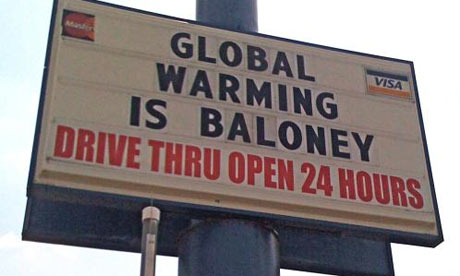
Meanwhile in Tennessee, Gore’s home state, Burger King owners have been displaying the following:


I guess they’d also support Chevron’s claim that toxic sludge is as harmless as moisturizer (Amy O’Meara provides a good breakdown of Chevron’s claims, as do Chevron’s shareholders). Apparently neither corporation has heard that some prominent physicians have named climate change as humanity’s greatest health threat; well, maybe after baloney.

Wednesday, February 04, 2009

Future Now?

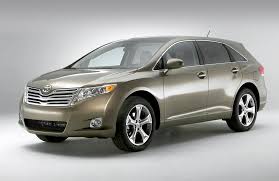
Toyota recently boasted, in a four page advertising supplement for the Venza, “Tell people you’ve seen the future and it’s got cup holders.” In general, I dislike these supplements as they are designed to deceive the reader — they’re in the same font and publication style of the “host” publication and only differentiated by opaque qualifications, such as “Advertising Supplement” — but I read on due to their bold proclamation. What I found, however, was not what I had expected: there was no mention hybrid-electric, bio-fuel, ethanol, or natural gas. In fact, the fuel economy was quite poor, 22 mpg (8.7 tons of CO2).


I wondered how such a car could be the future — sure it had plenty of performance, safety features, and cargo room, but shouldn’t such a pronouncement be reserved for vehicles like the Prius? I also puzzled at the disconnect between Toyota’s environmental image and this ad; after all weren’t they in the top five? No! Unfortunately, Toyota is ranked tenth well behind Mini, Honda, and Chevrolet (yes, Chevrolet) in first, second, and third for highest average fuel-efficiency. How could this be the case as they produce the Prius and Tacoma? The answer is they also produce a number of fuel-hogs in their lineup of 55 models and the Prius, the world’s best-selling hybrid, has only accounted for 1 million cars over 11 years. Even compact cars such as the Yaris and the Corolla, now numbering 15 million and recently surpassing Ford’s Model T for second most-sold automobile (the Beetle remains first by a long shot), cannot tip the balance. I never thought that Toyota would be behind a GM corporation in anything but sales.


The source data for these statistics on average fuel economy is actually quite difficult to come by, so it is better to stick with compilations by CNN, above, and blogs, such as Automotive Traveler and Ecogeek. The only disadvantage in doing so is the overestimation of Mini, which really only produces one car, although twelve models are listed. It is best to compare the Mini with Lotus and stand in awe of Chevrolet, which nearly equals Honda in efficiency and has over three times as many cars in its lineup; however, if one included Chevrolet with GM’s other brands these figures would plummet since GMC and Hummer are ranked as the tenth and ninth worst fuel-efficient manufacturers respectively.


For an enlightening production of the general phenomenon of widespread fuel consumption watch Who Killed the Electric Car?, a much more even-handed production than the title suggests. Nader sums it up best, that companies such as GM are "going backwards into the future." Another snippet of society’s prevailing distrust of alternate propulsion was Top Gear’s staging of a Tesla running out of charge while Jeremy Clarkson’s noted, “Although Tesla say it will do 200 miles we worked out that on our track it would run out after just 55 miles.” Although Clarkson can’t help being pompous, BBC could have avoided such a stunt. Nevertheless, everything worked out: Tesla was happy with Clarkson’s effusive praise on the car’s performance against a regular Elise and I was happy to witness Clarkson trying to transect Vietnam on a Vespa in a later show. (He was taken down a notch or two, though all in good fun, on this “barbaric” form of transportation.)
Tuesday, October 28, 2008

Rethinking the 3 Rs

While watching the Bill Nye episode, Garbage, with my kids, I was struck by their inclusion of re-think with reduce, re-use, and recycle. 4 Rs are better than 3: even good products, such as the BigBelly Solar need to be rethought. This product holds the garbage of five cans, is clean and self contained, but offers no choice for recycling. Instead a similar product with multiple compartments for recyclables, biodegradables, and garbage could be used to divert waste from landfills. Only balanced thinking will balance equation of our consumption. Perspective can be gained by touring landfills with tomorrow's generation to see how they divert waste (paper bans) and capture leachate and methane. There's no easy path, but integrating disposal into a product's design makes sense. I again praise the efforts of RoHS and hope to see such standards spread through all industries.

Tuesday, September 09, 2008

Science Fiction's new world hope

Science Fiction provides much of the myth for our hi-tech world; it has opened our horizons and suggested the pinnacles that we may reach. Although we have yet to reach the level of convenience and humanity portrayed in The Jetsons and Star Trek, Science Fiction continues to bring us hope (Kurzweil's Singularity). Nevertheless it has also brought us disillusionment (Where's My Jetpack) and fear (Terminator).

Science Fiction interprets the dichotomy of technology: progress AND destruction. No where is this more clear, now the threat of Armageddon in the Cold War has faded, than in climate change: the drive for faster better has technology = resources = production = pollution , yet the hope of the future lies in technology. However, it is unclear to what degree:


MTV Switch has also just released another great video, also produced by 180 Amsterdam. Talk of geo-engineering evokes a similar response (see Wired's recent article Ken Caldeira). Ironically discarded technology continues to pile up and create a hazard for those in Africa and China. There is some hope, however, such as the introduction of the RoHS (Restriction of Hazardous Substances). Meanwhile possibilites will remain just that unless common sense pervades our culture of greed. Will technology lead to a better world or a more inequal one? It's up to us.

Sunday, June 29, 2008

Getting here

A big part of me brightened when I read that SUV and big truck sales have plummeted, causing a shift toward the production of fuel-efficient cars and technologies. The success of Honda, which has the most fuel-efficient line-up, illustrates this point: it was the only company to show an increase in sales (1 percent) while the sales of other companies, such as GM, Toyota, Ford plunged by 18 to 28 percent. Another part of me asks, "How did we get here?" and "Why did it take so long to realize we were here?" In other words, "Why were SUV's ever so popular?" and "Didn't they lose their luster years ago?" Although I never purchased one, I recall being entranced by them, wanting one and thinking it would solve all my problems (I could go wind-surfing anywhere and sleep in the back). Nevertheless, a year or so after, me and my friends were mocking all those ads showing a "ute" that still had its last waxing untouched by dirt in the middle of a forest or on a mountain-top. Perhaps, their expression of power or not giving a damn made them so appealing. Perhaps, nostalgia drew us in; I still want to rebuild a 70's era Toyota Land Cruiser to relive my travels as a kid through deserts and jungles.

Likely, it's some wider marketing tool more closely related to Manufacturing Consent. The StoryofStuff does an excellent job of how this came about. Soon stories such as Vancouver City Hall's conversion of free parking spots to pay spots won't make the news. In other words, items that aren't free won't be considered as such. Besides an opportunity-cost, parking spots have many costs which remain outside of the profitability equation, oil and gas run-off being the most prevalent. The frequency of oil-logged pits in parking spaces and the rainbow effect of mixed oil and water after a rain hints at just how much oil leaks out. In the end, the eco-system pays, as do we: "Mercury with your fish, anyone?"

Sunday, June 08, 2008

A Fevered Earth?

As I freeze in the stands watching my son's baseball games I often hear, "so much for global warming." To me it's seems like the earth has a fever, exemplifying symptoms of being cold while it's hot. Climate change means that dramatic climatic events will take place more frequently, not that politicians like Gary Lunn and George Bush can hit the beach at all times of year. This program clearly and concisely lays it all out.

In the meantime there's much that can be done, and much is being done in parts of the world. Portugal is constructing the world's largest solar farm and by 2020 plans to generate one-third of its energy from clean sources. Paris, Barcelona, Copenhagen and Lyons have provided fleets of bikes available at self-serve kiosks throughout the city. In Paris, to borrow a bike you provide a credit card deposit and get the first one-half hour free and then pay accordingly. You can then leave bike at any kiosk. Unlike BlueBike programs which deterred theft by providing clunkers and never really took off, Paris's scheme is very popular. Lobby for similar goals and projects in your country; I am ashamed of Harper's goals and targets in mine.

Smaller-scale options include changing your spending habits and for "necessary" items purchasing green products. A number of clothing lines now produce clothes made from sustainable, organic, and fairly traded materials. MEC requires every cotton product to be 100 percent organic and even stores like Superstore offer the product. Bamboo is a great material because it absorbs four times the moisture as cotton and has anti-bacterial properties. Bamboo towels and sheets are awesome. Marks has a new line of bamboo briefs and Ingeo socks. They also have an Ethical Sourcing Program. In textiles, there's a wide variety of options out there (if you're ever in Victoria, head down to lower Johnson Street; you'll be amazed). Here's an article discussing some of them. It will be true progress, however, when all products are sustainably produced and biodegradable/recyclable, as they should be.

Wednesday, May 14, 2008

Climate Change: Some Issues

The amount of rhetoric on climate change has grown considerably as of late and the issues have become somewhat muddled. Here are some points to bear in mind.

a) Bio-fuels are not all bad. First, those produced from cooking oil and similar wastes have a net gain; that is, very little energy is required to convert them into bio-diesel and waste is consumed rather than disposed of. Second, each vegetable has a different input/output ratio. Much of the discussion on bio-fuel has revolved around corn, especially the high food prices (and resultant reduction in total aid). However, corn ethanol is not economically viable and never has been. (It takes 1 unit of fossil-fuel energy to produce a potential 1.3 units). To understand the reason corn why corn-ethanol is produced, one must examine the power of the corn lobby and Mexico's willful, but avoidable (under NAFTA), importation of America's subsidized corn. Sugar cane, on the other hand, has an energy ratio of 1 to 8 (1 in 8 out). The real potential (and future) of bio-fuels rests on cellulosic ethanols; with advancements in technology grasses, stalks from harvested plants, or algae could have ratios as high as 1 to 36. National Graphic has published an informative article on the topic of bio-fuels and has summarized the information here.

b) Advances in technology do offer hope, but there is no magic bullet. Solutions can be offered but they must be implemented and accepted. Here, regulation and mind-sets often stunts the profitable distribution of products, e.g., the ZENN cannot be driven in Canada and the Tata OneCat pneumatic car will probably never hit North America. In the Cold North I still hear people lament over the cost of heat-pumps, despite the break-even point of seven to ten years and low emissions.

c) Despite a growing selection of green products, which I support, it is not possible for us to buy our way out of the growing crisis. The reason is that most people in the West consume and pollute much more than the earth can support. You can test this assertion by calculating your global footprint (the number of earths that would be required if everyone on earth had the same standard of living). So far, our demand has been sustained by other countries with a lower standard of living (and demand on the earth). Now that many countries are becoming developed there's less to go around; as a result, reduction, not consumption, is the key. Nevertheless, when you do purchase items it is important to do so responsibly. To examine the possibilities of responsible living check out Dockside Green. Purchasing a hybrid, electric, and fuel-cell vehicle has an added benefit: they do not idle. In Victoria an idling ban is being proposed to reduce air pollution; however, these cars offer the better solution (the best though is walking, cycling, or taking the bus).

Thursday, May 08, 2008

Miscellaneous Delights

As spring arrives, the beauty of the world is revealed. Peace is easy to find: a birdsong beckons me to the forest and the tranquil trickle of a spring lulls my soul. Rays of warmth disrupt the dampness. The moss makes an inviting bed, but sleep does not come. It seems a part of me suspects this unfamiliar peace. Eventually sleep does come providing a rest thrice fulfilling than the time warranted. After a siesta the long days and pleasant temperatures cause me to dine out of doors. The food keeps well in the slight cool and no wasps or mosquitoes diminish the enjoyment of my meal.

Dwelling on spring reminds me of the goodness of the Earth and why I purchase organic products whenever I can afford it. Over the years I have purchased a number of organic wines, but besides the relatively expensive Bonterra wines, I have not been overly impressed. Terra Sana (in the Flash window, click Wines & Vineyards, then France, then Terra Sana) makes a very pleasant crisp white and a decent red, but it wasn't until I tasted Villa Teresa's 2007 Merlot that I was overcome. The Merlot is light in colour and weight and provides a semi-sweet fruity flavour reminiscent of a Beaujolais Nouvea. It makes a very nice aperitif or companion to a light meal, such as a lightly dressed salad or a pork loin roast. (Its subtleties would be overpowered by the rich flavours of fish or a strip loin).

Prior to subscribing to the Best of You Tube Podcast a year and a half ago, I really had no idea of the number of people with astonishing ideas and skills. Some of them are quirky and mildly entertaining, but some are well worth watching. For a sampling, check out 323 (Grand Central Freeze), 306 (Juggling with Hammers), 280 (Backflip on slackline), 129 (Ball Skills), 104 (Pool Trick Shots).

Saturday, April 26, 2008

Global Care, Cheap and Easy

Purchasing green products does decrease your footprint, but a number of solutions cost no money. Reducing consumption is an obvious one, but one that needs to be stated more often in North America. The Hungersite and its family of sites only require a click to make a donation to various causes or purchase endangered land. The donations are made possible by donors and advertisers. Over the years the website has been greatly improved, so the process is easier than ever (if you stopped clicking due to its inefficiency, try it again). The site has tabs down the side that contain concise information on a number of issues and fair trade items can be purchased through the site. EcologyFund works the same way as the Rainforest site. Both sites tell you how much land has been saved (on the Hungersite the info appears after you click, while EcologyFund has it in the sidebar); encouraging. I have these links in my Bookmarks Toolbar Folder, so it's easy to click every day (you can only do it once a day). To add them there, assuming you're using Firefox, just click Bookmark This Page and select Bookmarks Toolbar Folder.

Nature Conservancy Canada (NCC) has partnered with UsedEverywhere, so sellers can donate a portion of their sale to the NCC. Sellers doing so will have a NCC logo next to the item for sale.

Don't forget World Fair Trade Day on May 10th.

Friday, April 11, 2008

Recycling and Purchasing Responsibly in a Consumer Culture

The harsh reality of a lack of concern for the environment becomes apparent to me whenever I fish recyclables out of the trash. Landfill bans have lessened this experience somewhat, but initiatives, such as every public waste-receptacle having separate compartments for biodegradable, non-biodegradable, and recyclable would have a greater impact (I can't tell you the number of times I've had to hunt for a place to put my recyclables; that is, in every place except Cebu airport, which has these). Furthermore, a recent article has shown that Canadians print an average of 30 pages a day at their offices and discard of 40 percent of these immediately after printing; only a third felt guilty for this behaviour, while three-quarters were concerned about their impact on the environment, though apparently not concerned enough to use print preview and double check the number of pages selected.

Putting the waste in the proper receptacle and reducing paper (reading on the screen is much less strenuous with today's monitors and programs that manage files for easy retrieval, e.g., Endnote, RA Document Organizer, IdeaTracker, and others) requires little thought, especially if you've toured a landfill or a developing nation to see what the consequences are. Recycling has also become easier with the addition of a number of items, such as tin foil, to the recyclables list (I'll soon be posting another entry on recycling in Victoria, including how to dismantle non-recyclable items, so their parts can be). Nevertheless, much waste is generated by consumerism; if you don't wish to petition companies or research how much waste they produce, you can vote with your dollar, i.e., purchase items in bulk and with less packaging. Manufacturers also save money with less packaging or providing digital products in downloadable form and the amount of green house gases produced is greatly reduced due to resultant increase in transport efficiency (more items can fit in a container). I can't believe Thrifty Foods advertised items as "flown in" to emphasize their freshness, but which really betrayed the emissions generated.

You can also, with some research and care, choose products that have less impact on the environment. A number of classifications, such as Organic and FSC, provide a guiding hand. Of course, the environmental impact becomes more acute with the purchase of larger items, such as furnaces and cars; heat pumps and hybrids, in general, are the best option (ten years, the period it takes to recoup the additional costs goes by really fast). Many websites rate the energy efficiency of cars and other items, but beware because none of these ratings are standard like EnerGuide. Nevertheless, researching every day items can be tedious (it took me ages to find the Fuchs Ekotec toothbrush with a replaceable head); that is pre-Zumer.

Zumer is a new website, which is now in beta and offered by invitation (click the link to request a membership by email, from then on it's pretty much straight forward), that simplifies this process. Upon registering you fill out a questionnaire with four categories: EcoFriendly (I love the question of paper products with the option "I only use a bidet"), Social Justice, Product Advocate, and Corporate Watchdog. Then you search or browse for products, which are ranked according to these preferences. You can then click on each item to find out details about the product and the corporation that produced it. This feature is very helpful. Zumer covers a wide array of items from laptops to handbags and has a number of categories that are not active yet, so once the final version is launched it will be fairly comprehensive. The same goes for the inclusion of lesser known brands (often more environmentally responsible). This site is easy to use and I recommend it; look out for its official launch in the near future.

Once you get this process of making informed choices down it becomes effortless. Of course corporate responsibility and environmental impact can only form so many of your choices, but on the whole organic and socially conscious products are produced with greater care and taste better. Hopefully corporations will pay attention to Zumer and your choices and change their practises accordingly. See Walmartification, Creation Care, and Biblical Environmentalism for more on the environment.

Thursday, March 27, 2008

Walmartification

Those of you who have spent any time with me are familiar with my passion for the environment and purchasing of fair-trade items. I now, thanks to Ten Thousand Villages, regularly purchase fair-trade olive oil (the purchase of Zaytoun olive oil also supports Palestinian farmers), sugar, spices, chocolate, tea, and, of course, coffee. In addition to the awesome textiles and crafts at Ten Thousand Villages you can purchase fair-trade clothing at MEC and other awesome stores (lower Johnson Street in Victoria rules for this). Although some major outlets, such as Costco Canada now offer fairly traded coffee (it's not a joke), the mighty Wal-Mart has not. Wal-Mart with its huge purchasing power and demand for ultra low prices from suppliers goes against the very principle of fair trade. Read The Wal-Mart Effect to get some idea of the extent of its power. Many I talk to find Wal-Mart's allure hard to resist, but it can be done: I have yet to purchase an item from a Wal-Mart. Who needs all that cheap plastic crap that purchasers rarely recycle. To see how scary the Wal-Mart effect is watch this:


Awareness is key. Do you think it is possible to produce products super cheap without exploitation and extreme environmental degradation? Vote with your dollar and say yes to fairness. In addition to fair-trade and organic products you can look for businesses participating in the onepercentfortheplanet program. If you need some more motivation calculate your ecological footprint or travel to a developing country.

Monday, December 03, 2007

Creation Care

Last month I went to the Creating Wealth and the Created World conference at Regent College in Vancouver. They have just recently posted the notes and presentations of some of the speakers, notables such as Preston Manning and Clive Mather, on their website. The facts on the oil sands alone is worth a visit to the site. A favourite of mine from the conference was Cal DeWitt, he is an impressive individual who passionately yet eloquently communicated his concerns and wisdom concerning the environment. His work with the Town of Dunn, a sustainable community, is particularly laudable. All of the ordinances are posted on the website, so other towns can use them for their own use.

See Biblical Environmentalism? for more on this subject.

While I was speeded to UBC aboard the new network of express buses I read that TransLink intends to implement a wireless system which will post information on arrival times, change traffic lights so buses can maintain their schedule and, perhaps, offer wi-fi on board the bus (something even B.C. ferries can't even pull off). My bliss on public transit was rudely interrupted when I had to wait for 25 minutes for the bus to arrive on the Swartz Bay side. Then the bus weaved its way through Sidney and many hours later I made it home. Victoria transit, in my experience and to my chagrin, runs has buses arriving early at stops (sometimes up to 5 minutes early) and has poor connections, although I have seen some progress on the latter in recent years.

Friday, May 26, 2006

Getting It

Since I read the article Duchy of Cornwall in the May 2006 issue of National Geographic, I have a few apologies to make. I was lulled into a diminished of view of Prince Charles, but now have much greater respect for him. Although the maximum level of respect that he can get from me is still hampered by his treatment and fall-out with the most popular woman of this age (her funeral attendance says it all), I would like to apologize for thinking he was completely without judgement. Not only does he have judgement, but he also "gets it" and puts his money where his mouth is. The town of Poundbury says it all. As does the following quotes from pages 102 and from the article:

"'It very nearly didn't end up like it is now because there were efforts to water it down', the prince said. 'But we have probably shown that for a ten percent extra cost, roughly, you are actually achieving a far higher value in the longer term than the shorter term, which is the way the modern world looks at everything.'"

If only Bush could think the same!

"'In farming, as in gardening,' the prince once wrote, 'I happen to believe that if you treat the land with love and respect (in particular, respect for the idea that it has an almost living soul, bound up in the mysterious, everlasting cycles of nature) then it will repay you in kind.'"

Saturday, May 06, 2006

Biblical Environmentalism?

Given that the Protestant work ethic derived from a specific set of verses from the Bible and that this ethic contributed to a consumer driven economy that, in turn, created large-scale environmental degradation, is a biblical view on environmentalism feasible? Since the main focus of the Bible is the relationship between humankind and God, and the relationship among humans Mark 12:28-31 (Deut. 6:4-5), a view of this kind must be derived from a group of scriptures. The first group of scriptures that I will consider concern God’s relationship to earth.
  • God created the world and it is his (Gen. 1:1, 1Cor. 10:25-26 [Ps. 24:1], Col. 1:15-20).
  • What God created was good (Genesis 1:20, 25; Is. 6:3) and a source of joy (Job 38: 6-7).
  • God controls the earth (Deut. 10:14, Ps. 50:1, Ps. 147:8, Acts 16:26).
  • He uses it to exact judgment (Num. 16:32, 2 Chron. 7:3, Ps. 46:8, Is. 13:13).
  • The earth responds to God (Ps. 98:7-8, Ps. 148, Ps. 97:5, Ps. 77:18, Psalm 46:6).
Clearly, the Bible states that God created the earth, cares for it and interacts with it.

The second part of this analysis concerns what the Bible says about our relationship to the earth.

  • God appointed us as stewards (Gen. 1:26, 28; Gen. 9:1-3).
  • What does it mean to rule or be given everything in your hands? Note that God demands an accounting from the animals as well (Gen. 9:4-5, Ps. 148:13, Prov. 28:3, Is. 32:1, Matt. 5:5, Lk. 1:52).
  • There are warnings and consequences concerning our role (Is. 24:5-7, Hosea 4:1-3, Jer. 51:25, Rev. 11:15-18).
  • Our commission regarding the earth (Matt. 6:19, 2 Pet. 3:13, Is. 45:8, Is. 66:1).

Main questions for thought, given the above analysis:

  • What are our priorities, duties and responsibilities to the earth and the poor?
  • What is our relationship to the earth?

Answers:

Romans 1:20

For since the creation of the world God's invisible qualities—his eternal power and divine nature—have been clearly seen, being understood from what has been made, so that men are without excuse.

  • There is a correlation between consumption and pollution. Can the above be true in a polluted city?

James 1:27

Religion that God our Father accepts as pure and faultless is this: to look after orphans and widows in their distress and to keep oneself from being polluted by the world.

  • There is a correlation between consumption and poverty (ecological footprint, above).

Hebrews 6:12

We do not want you to become lazy, but to imitate those who through faith and patience inherit what has been promised.

  • God cares for the earth so we should.

What can you do?

  • Recycle.
  • Buy responsibly – buy more local produce and less exotic produce and buy fair-trade to ensure farmers in other nations can make a living.
  • Buy organic to nurture the earth.
  • Drive less.
  • Complete your footprint to see what you need to work on.

If you want a version with the full scriptural references post a comment requesting it with your email and I will get one to you.

The reason that I am passionate about the environment is that when I first moved to B.C., in the 1980’s Acid Rain and the Greenhouse Effect were plastered on the front cover of a majority of publications. As time went on I witnessed logging protests, etc… Like many students at university I explored new ideas and was passionate in the expression of these ideas. It was during this time the 3-R’s became popular and the time that I first recycled, bought bulk items to avoid packaging and visited the Walbran. Today I still recycle, avoid saran-wrap, bike as much as possible, etc... Unfortunately, I have an ecological footprint of 4.6 earths (the amount needed for everyone on the earth to live at the same lifestyle). The NA average is 6.9 earths. I used the MEC one (www.mec.ca/coop/communit/meccomm/ecofoot.htm); my results for myfootprint.org were 3.5 and 4.7 earths respectively. Thus, the future in this area always looks bleak as so many people live “without” to sustain that which I use. There is no equality here, but I realize that the less room I require, the more room there is for others. Thus, choices of consumption in North America are important and a way to bring social justice to the world. The bottom line is not the lowest price, but rather ensuring that others are treated as Jesus would have treated them. I won’t even mention sweat shops.

Wednesday, May 03, 2006

Defying Nature

The desert in Phoenix does not resemble that of Jordan much; while Phoenix abounds in plant-life, Jordan does not. The blooms that these plants create in mid-to-late April seem to especially contrast the hard-pan found in Jordan. While there, though, I could not escape the parallels brought by my recollection of a large pool in Humayma. At first thought, this pool in the middle of a very dry desert appears to be a cistern. Upon further reflection this supposition seems unlikely because there is no evidence what-so-ever of a roof to minimize evaporation. In addition, all the other cisterns on the site were covered. Nearby Petra has similar remains of a large pool. The most likely theory put forth is that these pools were for recreational purposes alone. A further supposition is that they were built to display the ruler's ability to thwart nature. In Phoenix a similar attitude prevails. There is no visible water conservation. Since I live in a rain-forest and I am limited in how frequently I can water my lawn, I can only suppose that Phoenix does not limit lawn-watering to display man's advantage over nature. Open canals and a number of man-made lakes and rivers seem to strengthen this point. The lack of low-flush toilets and water-saving shower heads also emphasize this point. Conservation in any way was lacking in Phoenix, from recycling to the widespread use of HUMVEEs (the only hybrids are the buses). Although Phoenix may be an oasis in the desert, it cannot be one responsibly for so many people. I hope by my next visit that my hotel won't change the sheets, soap and towels against my wishes (my wife left a note not to do so) and that I find more than two recycle bins in my travels.

Reverb

Reverb plug-in