Showing posts with label Archaeology and History. Show all posts

Saturday, April 11, 2009

Medea

Although buildings rise for numerous other faculties at the University of Victoria, the administration has no immediate plans to construct any for the Faculty of the Humanities; however, crumbs do fall, since Humanities gets assigned the vacated space of other faculties. Nevertheless, the faculty remains rich in many other ways—one of its treasures, the Lansdowne Lectures, has brought outstanding scholars to UVic for over 30 years. At a recent GRS gathering for Ian Morris, the most recent Lansdowne recipient, the conversation turned to modern portrayals of ancient Greece and Rome. Due to the labours of scholars, such as Keith Hopkins, moderns have a much more comprehensive view of ancient Roman society. Gritty productions, such as HBO’s Rome, have supplanted Sword-and-Sandal epics and portrayed the city’s eastern lavishness:


From every land and sea are brought the fruits of each season, whatever all the farms and rivers and lakes produce, by Greek or barbarian techniques. It follows that, if anyone wishes to behold all these things, he must travel the known world to gaze on them—or he must be in Rome (Aelius Aristides, To Rome 10–11).


The lowest estimate has India, China, and the peninsula of Arabia removing from our Empire each year some 100 million sestertii. That is the price our luxuries and our wives cost us (Pliny, Natural History 12.84). (Both translations from Greek and Roman Technology, p. 494–5).


Nevertheless, the same cannot be said for ancient Greece: modern society still view this culture through the clean crisp lines of fluted columns. Sanctuaries (the focus of my research) were lively gathering places that fulfilled a variety societal functions: exhibition, mediation, and protection; furthermore, Greek democracy comprised a series of public oaths, duties, and oratories.


One exception, however, is modern portrayals of Greek drama. Ground breaking productions, such as The Gospel at Colonus have led the charge and scholars, such as Helene Foley, who requires senior students to produce a play themselves, have supported these productions. Over the years, UVic’s Phoenix Theatre has produced a number of Greek tragedies and comedies, and garnered abundant praise for their efforts. Euripides’ Medea, their latest offering, stunned audiences.


Not only did modern events, such as a father murdering his five children, make the play extremely relevant, but the play was stellar from the foundations. Linda Hardy, the director, embraced Euripides version of the myth in which Medea murders her own children to spite Jason. The changes the director made to the text were sensible, such as expanding the role of the tutor and adding a nurse. The stage designers also excelled, creating a functional and mystical setting:


The choreography successfully integrated the chorus with the rest of the cast. The chorus itself, consisting of vocalists specialized in various genres, scintillatingly oscillated between screams, hums, and cries. Lastly, and most deserved of praise, the actors, in particular Katie Takefman who played Medea, provided the audience with an emotional/philosophical roller-coaster ride that evoked the cathartic intention of ancient Greek tragedy.


Tuesday, March 03, 2009

Modern Excavating

Technology continues to expand our capacity to explore the past. Given the current instability in Afghanistan, nearly every western archaeological excavation has been halted. This, however, has not disrupted work in the area: archaeologist have turned to Google Earth to discover and catalogue a number of sites. Satellite imagery remains effective at revealing transport routes and other human traces, but Google Earth makes it that much more accessible.


Google Earth’s 3D map tool has been used to reconstruct a number of ancient cities. Whereas the Forma Urbis Romae and the Plastico di Roma Antica required countless hours to render Rome’s finery, digital versions take much less time and provide greater detail.


The practice of naming children according to the availability of domain names seems absurd, especially with the impending expansion of Domain Names. Nevertheless, the list of the most unfortunate names, e.g., Justin Case and Hazel Nutt, doesn’t contain many of these web based monikers (yet). Unlike these new-fangled proper nouns, researchers claim to have dated the English words “I”, “we”, “two”, and “three” back tens of thousands of years using computer models.

Thursday, January 29, 2009

Discoveries

Bacon ExplosionThis Sunday, thousands are expected to wake up early, take a couple of pounds of bacon and sausage from the fridge, and prepare a Bacon Explosion, the latest in excessive-fare (even replacing the turducken, which has been relegated to seasonal fare). Although many may amend their definitions for “rich” and “fatty” amidst the flash and glam of the Super Bowl, and perhaps justify their consumption by the large array of performances, a number of relatively mundane discoveries have been made recently.

Mark Aretz, an architect and renovator in eastern Germany, opened the door to an apartment that appeared to have remained untouched since 1988. He found a calendar on the wall turned to August 1988 and a variety of East German products; only one “western” product was found, a bottle of deodorant [all puns purposely omitted]. Apparently the occupant had to flee from the East German authorities and had abandoned everything, including a bottle of vodka.

In Istanbul archaeologists have discovered a grave that pushes back the date of first habitation 6,000 years (700 BC to 6,400 BC). The grave is located in a swamp and nearby they found evidence of houses constructed of tree branches.

At the AIA, Dr. James presented a paper which suggests that the Persians were the first to use “chemical warfare” against their enemies. The paper shows that Persians, in the 3rd century AD, tunneled under the Roman city of Dura in modern Syria and ignited a mixture of bitumen and sulphur crystals to poison the Romans working in a counter- mine.

Tuesday, March 25, 2008

Sacred Spaces

I haven't been blogging much lately because I've been working on my thesis and a talk I gave at UVic last week. I have been researching the impact of natural features, such as caves, springs and forests, on the placement of sanctuaries. Here are a few photos I found of modern examples of this phenomena.

Catholic church in Palompon (Leyte, Philippines).

Church in Cairo.

Athens in a cave under the acropolis, an ancient shrine converted to a modern one. I shall have a good chunk of my thesis done very soon. When that is done I have a bunch of posts that I've roughed out that will get fixed up and posted.

Latrines to Lavatories: an aesthetic journey

Roman latrines were a technological marvel that brought efficient and large-scale sanitation to the world.


This latrine at Ostia, though heavily re-constructed, shows that some care was taken in its decoration (the walls would have been plastered), especially compared to the "facilities" of the Middle Ages:


Of course, there were some sophisticated examples:


In the modern age, the lavatory in the Sao Joao da Madeira shopping center in Portugal surpasses all.

The Cafe Batavia has the coolest sinks.


Here's a more complete history.

Saturday, March 18, 2006

The Gnome

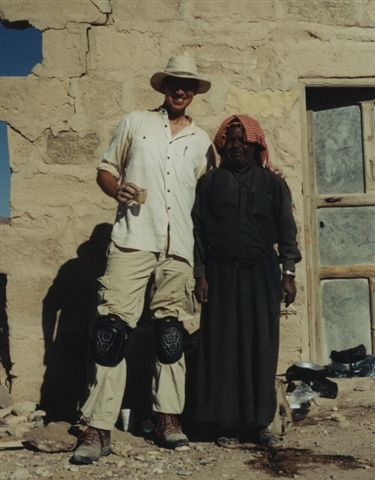
I do not want to continue much further without talking about the Gnome. He was my Jedi-like master, who trained me in the ancient arts in the desert of Jordan. I was working on an archaeological dig there and was first drawn to him by the confident aura he exuded despite his stature and weathered face. I then watched him for a while and noticed a few things about him. It wasn't that he was anti-social, just that he lived by the old ways, when he made his own tea while others shared theirs. His tea was always made in his own teapot, on his own stove away from the others. I do not know whether others could contaminate his tea, but out of fifty Bedouin workers he was the only one to make and drink his tea alone. The same held when it came to preparing the on-site breakfast, careful and premeditated actions. He lived by the code, in fact he embodied the code of elite warriors that had passed through countless generations of the wisened few to our age. Now those since the last generation have incorporated modern technology with the old ways to create a new way of being. Here is a picture of the Gnome and one of both of us while working on the site (away from our training camp).


Reverb

Reverb plug-in