Showing posts with label Travel. Show all posts

Friday, June 25, 2010

World Cup Fever - Final Impressions, A Canadian's View

At the beginning of every World Cup game I'm struck by the colonial influence on each nation's anthem. Western instruments, chorus lines, and structure predominate. There's no rumba, salsa, or cross-rhythm, and that's such a shame, given the diversity among each nation's fans and players. Fortunately, the music at taxi stands, airports, and fan parks weren't restricted to western notions, and, of course, the vuvuzellas made stadiums their own.

I took quite a few bus-taxis and buses to get around from my remote abode. Although people on the bus-taxis were quite friendly, especially when I repeatedly asked Illovo? or some other destination, people on the bus ignored me. I discussed this behaviour with a white South African after, and she attributed it to the fact that a white person on such buses is a rarity, never mind one with an accent. By the way, from what I've gathered South Africans refer to each other as black, white, or coloured (any ethnic mix other than the former two). I struggled with this terminology due to my North American sensibilities, but soon tired of unnecessarily tip-toeing around.

Another sensibility that I lost pretty quickly was pedestrian right-of-way. Drivers gave me courteous beeps, but such notions can be dangerous (I had a few close calls in my jet-lagged stupor). Like Europe, standard transmission dominates the market, so drivers are quite skilled, but the numerous construction projects made navigation difficult. I still can't get over the lack of seat-belt laws. I desperately wanted to fasten a belt around the new-born in the front seat. Although I wanted to stay and try to get tickets for the Brazil/Portugal, which turned out to be rather flat, the time had come for me to go. I made it to Sandton (an up-scale suburb into which a number of downtown businesses fled when the fence came down) and then to the GauTrain.

The train was filled with residents excited by the prospect of travelling at high-speed. They marvelled at the new smell and efficiency, and some claimed superiority to London's tube (not a fair comparison). I was buoyed by their enthusiasm. The driver came on the intercom, introduced herself, and announced we were travelling at 160 km/h. I was one of the few to leave the train; I picked up some last minute souvenirs and made for my gate. I flew Etihad to Abu Dhabi once more. There were many empty seats so I quickly grabbed a middle row, so I could stretch out later. The meal included a chicken tandoori breast and three bean salad and a choice of chicken tikka, grilled hake or penne in cream sauce. Then I slept. No movies needed on this leg. No World Cup on a single TV in the airport. What's with this place?

After a drowsy day in Frankfurt I boarded a Swiss Air flight to Zurich. The stewardess had a topless picture of Drogba on her serving station and defended her choice, stating that he was her motivation. Swiss chocolate and a great Duty Free catalogue made their low take-off-and-landing priority bearable. I then flew Swiss Air to Montreal. The service, chocolate, and Movenpick ice cream was excellent, but the entertainment system ran on a rotation so you couldn't watch what you wanted when you wanted. The kicker, however, came when I boarded an Air Canada plane and paid $7 for a stale wrap.

Canada really needs to welcome its citizens. Rather than calculating potential tax revenue, citizens shouldn't have to fill out forms or stand in a general line. Where's the Canadian Passports line? It's as rare as a default choice of "Canada" on a Canadian website form. Anyway, I'm back; nearly over 29 hours in the air and nearly acclimatized to Victoria's poky drivers.

Wednesday, June 16, 2010

World Cup Fever - Johannesburg Impressions, A Canadian's View

Whenever I travel outside of North America I'm astonished by the grip of western culture. Johannesburg is no exception; a mall culture is particularly strong here. Malls host all the parties and have all the big screens and FIFA centers. They seem to be “the place to go”, much more so even than in North America. Thankfully, there's little evidence of big box stores although the city is car-centered and lacks efficient public transit. Nevertheless, this role's been filled by shuttle taxis which, although intimidating to visitors, seem quite effective. I was surprised at the lack of seatbelt use especially in the case of infants who rest on their mothers' laps in the front seat. There are some traces of the colonial past, the architecture and rusks appearing on aisle markers in grocery stores. Despite all this evidence of western culture many things set this city apart.
  • Some malls contain flea markets. Only a few are heated.
  • Entertaining store names and slogans:

Pick n Pay (As opposed to Pick n Run?) Their by-line, “Inspired by you,” has little to do with their brand.

Mr. Delivery for pizza.

Clicks Pharmacy: Clicks Clubcard. Saving is the point.

  • Fences. Electric, concrete, and steel. Every structure is well fortified. Perhaps the most striking example is the university whose fortifications seem to contravene tenants of higher learning, such as openness and right to protest.
  • BP appears to be doing quite well and has been running ads promoting their non-Fair Trade coffee.
  • No headphones on people. People spend time at bus stops in conversation.
  • Noises, of so many kinds, fill the air. Drivers toot horns to alert pedestrians who have no right of way here. Vuvuzellas fill the air, especially when South Africa is playing, then they begin at dawn and last until dusk.

People here are very friendly and most are quite excited to meet a Canadian. They ask many questions about Canada. Some, assuming I'm a white local have even asked me for directions. I've spent the most time speaking with Victor, the caretaker and my host, Alima. Victor is from Malawi and is working here to support his family back home. He's hoping to start an IT business here or a kindergarten back in Malawi. If anyone knows of some free school supplies, let me know.

Alima is fiery, passionate, and very kind. She addresses every black South African as brother or sister. They have a really cool culture which blinds the visitor to all the uncompleted projects, delays, bus strikes, leaky taps and lack of recycling.

A note on security: Although security is a major concern here, I've not felt threatened once. (I walk or taxi everywhere.) I have, however, felt a certain fear in the air, heard conversations about car-jacking, and seen reports of home invasions. This is enough to restrict my travel at night to well-worn routes.

Tuesday, September 02, 2008

Sidney Island

For me and two friends, Labour Day weekend marks more than the end of summer, our annual trip to Sidney Island. We take the kids that are out of diapers and camp for a couple of nights, a dads and kids weekend. The kids spend most of their time at the beach and we kick back. We catch-up and, like most of the camps, treks, and excavations I've been on, hum a theme song (a song which pervades the social consciousness of a group and seems to posses its own agency in doing so). This year, Take it on the Run by REO Speedwagon was on our lips, which isn't that bad a choice if you consider that parents frequently sing kids songs; at times I find myself singing the clumsy adaption of the 12 Days of Christmas for the LeapPad and some of the Barney's Favorites that my daughter repeatedly plays. Nevertheless, we are products of the Eighties, so it's no surprise Hey Rosetta, Wintersleep, and Tanya Tagaq songs don't become theme songs, despite their worthiness. Our '80s perspective, however, offers us much expertise in judging least deserving hits; this year The Boys in the Bright White Sports Car edged out TNT in the Simplest Lyrics category. Since we are upfront about our association with the Eighties, it is surprising that some radio stations, such as Jack, aren't. The Atlantic Monthly has this to say about the Eighties, "Like relentless zombies in a horror film, '80s nostalgia acts keep trudging along, undaunted." What is surprising is that my wife can still run into a teenager who yells, "Judas Priest rules" two inches from her face. I guess we'll have to endure for another generation or so.


Sidney Island's an idyllic setting for camping. Every time I'm there, I often pause in wonder at the surrounding vista: the stars also shine brighter here, so much so that it's like getting a new prescription. The island boasts a herd of fallow deer, which reminds me of the antelope that roam in the same dry, knee-high grass of the Serengeti. This year Parks Canada has installed some interpretive signs about the wildlife and history of the island; however, they've omitted the bomb shelter. It is a long rectangular structure with a vaulted ceiling and sturdy walls; two benches line the long walls and would have seated 20 or so. The grass roof and location amidst the trees would have kept it well camouflaged, but it is difficult to ascertain why it was built in the first place, given the low likelihood of an attack. Perhaps, the owner was caught up in the same hysteria that resulted in the Japanese internment camps. Nevertheless, it's well worth the visit; just wander about 500 metres SSE of the barracks to just inside the tree-line (east of the dead trees).

Tuesday, May 09, 2006

Nothing

Nihilism, to me, is much easier to embrace if you don't have children : the hope for the future. Children have been and will continue to be a constant reality on this planet. Many different events float upon the winds of time, but the hope for something better and different, present in a new-born, will remain. Also, M. Scott Peck surmised that it is difficult to understand the human condition without having children. Pets are no replacement in this aspect, as they do not naturally outlive humans or carry-on any genes or heritage. Children are more selfish than most parents, so they force (condition over time) the parents not to be selfish. These aspects of parenthood typify unselfishness, which also looks forward in time. Nihilism is intrinsically selfish as it concerns the present, specifically the view-holder's own present and ignores both ancestors and the hope for the future.

Something:
When my wife and I visited Taliesin West we were rejuvenated after the tour, contrary to our expectations. All the walking in the heat would have dictated tiredness had it not been for the incredible design of the place. I was puzzled as to what exactly created this energy until I read the following account by Val Cox in vol. 13.4 of the Frank Lloyd Wright Quarterly:

I realized that just by walking through the buildings at Taliesin and Taliesin West, you’re receiving something all the time. I know everyone feels that. It takes place in the texture and colour and interplay of the forms. It’s almost like a thousand magnetic fields that you’re passing through. And each time you pass through, just walking through the pergola or whatever, you’re absorbing something. And you don’t know what it is and you couldn’t put it into words. But as your life goes on, it starts to flow back out in a way that’s not arbitrary, or as a result of analyzing and coming to conclusions. As Mrs. Wright always said, ‘It’s in the marrow of the bones.’ And it just radiates from you.”

Monday, May 08, 2006

Guest Friendship

The tradition of guest friendship extends far back in time. For instance, read Genesis 18:1-15, Judges 19:16-30 and various instances in the Odyssey, e.g. the famous, Nausikaa passage. I have witnessed this practice in many parts of the world and always feel somewhat unsettled when I am greeted so warmly and favoured so much by people that are truly strangers. I think I do not feel entirely comfortable in these situations because the situation does not make sense in a "typical" North American framework. In most of the urban centres of North America one does not usually welcome and entertain a stranger who is passing through town. This may be due to many things, including distrust and the often used situation in Hollywood movies to set up a murder or similar crime. Also, the culture in North America tends to dictate that you need to deserve something to receive it. While this mentality is a strong basis for a strong work ethic, it doesn't necessarily lead you to be generous or receive unwarranted generousity. Why, in some cultures and communities, am I favoured for being a stranger? I think that this preference is due to survival and is more present in cultures that live in harsh environments. Thus, survival depends on sharing. Who knows when you yourself will be stranded in a desert or tundra without a hope? Fun-loving cultures also have a unique way of welcoming you in celebration. Lastly, in my experience in North America it is the minorities (immigrants and aboriginals) that are most proficient in extending generousity to strangers. This experience is ironic as many attempt to marginalize them or state that they only take; when, in fact, it is they that give.

Thursday, May 04, 2006

Beginnings

While living in a community that was, literally, a clearing in dense jungle with ATCO trailers placed in neat rows throughout, I decided to embark on a journey. The easiest trail was the road out of town made for the transmission lines. After heading up the steep pitch, for what seemed like hours, we ran into some local workmen. Here, I was given my first taste of coffee; however, this drink was sweeter than anything I had tasted. I felt guilty and happy that I had sweets so early in the day. We went on from the workers for a while when I spotted it to my left: the low lying caves surrounded by jungle. Somehow I knew these were the "burial caves" and to this day I am unsure of whether the many skeletons and Dutch coin were real or a dream.

Wednesday, May 03, 2006

Defying Nature

The desert in Phoenix does not resemble that of Jordan much; while Phoenix abounds in plant-life, Jordan does not. The blooms that these plants create in mid-to-late April seem to especially contrast the hard-pan found in Jordan. While there, though, I could not escape the parallels brought by my recollection of a large pool in Humayma. At first thought, this pool in the middle of a very dry desert appears to be a cistern. Upon further reflection this supposition seems unlikely because there is no evidence what-so-ever of a roof to minimize evaporation. In addition, all the other cisterns on the site were covered. Nearby Petra has similar remains of a large pool. The most likely theory put forth is that these pools were for recreational purposes alone. A further supposition is that they were built to display the ruler's ability to thwart nature. In Phoenix a similar attitude prevails. There is no visible water conservation. Since I live in a rain-forest and I am limited in how frequently I can water my lawn, I can only suppose that Phoenix does not limit lawn-watering to display man's advantage over nature. Open canals and a number of man-made lakes and rivers seem to strengthen this point. The lack of low-flush toilets and water-saving shower heads also emphasize this point. Conservation in any way was lacking in Phoenix, from recycling to the widespread use of HUMVEEs (the only hybrids are the buses). Although Phoenix may be an oasis in the desert, it cannot be one responsibly for so many people. I hope by my next visit that my hotel won't change the sheets, soap and towels against my wishes (my wife left a note not to do so) and that I find more than two recycle bins in my travels.

Monday, May 01, 2006

Desert in Bloom

I sensed that familiar spicy-smell, upon getting out of my car at King Tut's. "What a surprise?", I thought, "my wife suggested a Nargila bar." We had just arrived in Phoenix late at night and joined all the trendy youth hanging out at "Tut's". We had a great meal and I was constantly reminded of all those great times I had in Jordan. The next day we hung out at the hotel pool and I almost finished Eats, Shoots, and Leaves. Amazing! No children to interrupt me, just me and my book. In the evening we joined the start of the festivities for a good friend of ours that was getting married the next day. This evening was the rehearsal dinner at the Wrigley (yes, that family) Mansion. The night was a complete blessing and conversation flowed easily at our table. The only puzzling fact was the Flemish-style artwork on the walls of a hacienda. These seemed dark and out of place among the bright walls, creosote wood, and terracotta.

I really do love the desert; like putting on familiar clothes, it feels comfortable. Fortunately, the next day we went to Taliesin West and had the most amazing experience. In the desert stands Frank Lloyd Wright's winter residence and school. This place does blend in with the natural environment just as he intended. In addition, just like floor lighting and drive through banks, his innovation of organic architecture was years ahead of his time. One recent building was built from a plan of his that was sixty years old and the structure blends in beautifully with the modern skyline. Highlights were the piano niche, cut glass to accommodate vases on a too-narrow shelf and the canvas roofs. Learning of his mentoring approach also made a deep impact on me. Despite the long journey, my wife and I felt particularly invigorated after this trip.

Saturday, March 18, 2006

The Gnome

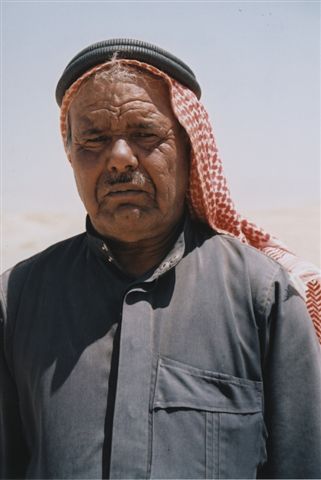
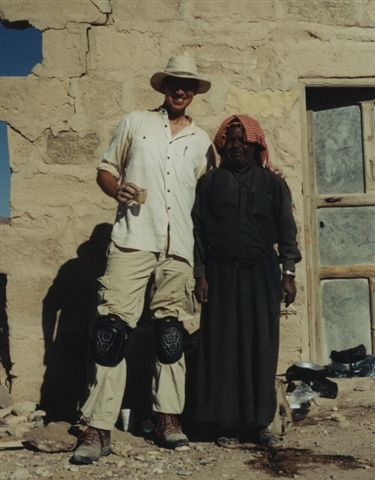
I do not want to continue much further without talking about the Gnome. He was my Jedi-like master, who trained me in the ancient arts in the desert of Jordan. I was working on an archaeological dig there and was first drawn to him by the confident aura he exuded despite his stature and weathered face. I then watched him for a while and noticed a few things about him. It wasn't that he was anti-social, just that he lived by the old ways, when he made his own tea while others shared theirs. His tea was always made in his own teapot, on his own stove away from the others. I do not know whether others could contaminate his tea, but out of fifty Bedouin workers he was the only one to make and drink his tea alone. The same held when it came to preparing the on-site breakfast, careful and premeditated actions. He lived by the code, in fact he embodied the code of elite warriors that had passed through countless generations of the wisened few to our age. Now those since the last generation have incorporated modern technology with the old ways to create a new way of being. Here is a picture of the Gnome and one of both of us while working on the site (away from our training camp).


Reverb

Reverb plug-in